

Health Benefits of Cinnamon…the Spicy Spice!

Before we get started, always remember that when I post info, it is not meant to treat, diagnose or cure an illness.  This information should also not take the place of what your healthcare provider has instructed you to do.  Please always speak to your healthcare provider before beginning anything new, natural/prescription or otherwise.

Okay, so what is cinnamon and where does it come from?  It is a spice that comes from the inner bark of a variety of trees from the genus Cinnamomum.  Is is very versatile in that it can be used in savoury or sweet dishes.  Some of the health benefits of cinnamon claim to be even supported by scientific research and this spice has been used for its medicinal properties for thousands of years.

The flavor of this spice comes from the essential oil that only makes up 0.5-1% of its composition.  This oil is prepared by pounding and mashing the bark in sea water then distilling the mixture immediately.  Both cinnamon’s taste and scent come from cinnamic aldehyde or cinnamaldehyde, which is about 90% of the essestial oil that comes from the bark.  The cinnamaldehyde is responsible for most of cinnamon’s powerful effects on health and metabolism.

So how do we get the powder form of cinnamon?  Since the spice comes from the bark of trees, once the inner bark is taken out and dried, it curls to form a stick.  The stick can then be pulverized into the powder form.  The picture below is of cinnamon from my kitchen.  I have been using the more common, Cassia variety.  Read more about it below.

20160127_142320

There are two main types of cinnamon:

  1. Ceylon Cinnamon or “true” cinnamon
  2. Cassia Cinnamon, the more common variety today that we think of as cinnamon

Claims to Fame as far as health benefits:

  • Full of antioxidants which protect from free radical damage because it is loaded with a substance called polyphenols (remember this from Tumeric)?.
  • Anti-inflammatory action that may also be due to its antioxidant effects and this may help to decrease the risk of disease.
  • Cinnamon may decrease heart disease.  It may help to reduce total cholesterol, LDL (bad) cholesterol and Triglycerides, while keeping HDL (good) cholesterol stable, with even as little as 120 mg per day.
  • This awesome spice can also improve sensitivity to the insulin hormone, which is one of the key hormones responsible for the regulation of our metabolism and use of energy.  Cinnamon can reduce insulin resistance, thus helping the insulin to do its job!  Blood sugar levels can decrease due to this action.
  • Cinnamon also can decrease the level of blood sugar, thus having a powerful anti-diabetic effect.  It can decrease how much glucose that enters into the bloodstream after eating by interfering with a number of enzymes that help us to digest food.  This slows down the break down of carbohydrates.  There is also a substance in cinnamon that can act on cells by acting like insulin.  If taken at doses as little as 1/2 teaspoon per day, you may be able to see these benefits.
  • It may show promise in neurodegenerative diseases such as aAlzheimer’s and Parkinson’s Disease.
  • May show some promise in protecting against cancer, but many more studies need to be done.
  • Cinnamaldehyde, the main active component of cinnamon may also help to fight bacterial and fungal infections.   Also can decrease bad breath and prevent tooth decay due to its antimicrobial effects.  Who can use better smelling breath right!

How do I get this spice?

It is better to use Ceylon “True” Cinnamon, but most supermarket cinnamon, which is cheaper, only have the Cassia variety.  Ceylon can be found in some health food stores or on Amazon.

Precautions

Best to stick to small doses of the Cassia variety if this is used to avoid unwanted adverse effects.  In patients with liver problems, due to the bleeding risk from the component coumarin (a blood thinner) that may be present in some Cassia varieties, the risk of toxicity and bleeding may be higher.

Also, patients with diabetes should be careful because of the blood glucose lowering action.  Speak with your healthcare provider first so that you can monitor your blood sugars more closely and if needed, your healthcare provider can adjust any other anti-diabetic medications that you may be using at the same time.

References:

https://en.m.wikipedia.org/wiki/Cinnamon

http://authoritynutrition.com/10-proven-benefits-of-cinnamon/
More Info about Tumeric

Tumeric is such an amazing herb that I had to write more about it and the practical ways in which I use it on a daily basis in my home.

I have found truth to the claims that it is an immune system booster, great for alleviating pain, good for healthier looking skin, great for joint flexibility and so much more.  It has been used for thousands of years and has been used in Ayurvedic medical practice in India.  A few other things I did not know about it is that it supports healthy eyesight and that it supports healthy respiratory function.

How much tumeric should you take?

As always, you should ask your doctor, however, many doctors are not into non-pharmaceutical healing.  I can only report to you what has been done by various individuals and ask that you be responsible and talk it through with your healthcare provider before trying anything.  There are so many drug-drug and drug-herb interactions that it may also be helpful to download an app to your phone.  Its great for preliminary information on interactions and is called “Natural Medicines Database”.

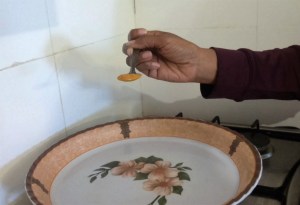
I have found various sources that say that to gain benefit from tumeric, you should use about 1 teaspoon a day of the ground dried root powder.  20160122_115521 (2)

I buy tumeric from the grocery store in the spice section.  Make sure to read the label so that you are getting 100% (or as close as possible).  I suspect that a small amount is curcumin, about 2%, but just remember that all brands are not created equal.  My label looks like this:

20160122_120358 (2)

If you do your own research, you will find dosages vary a lot, mainly because some studies have used them for prevention of unwanted symptoms or disease and some studies used it in curative doses.

So how do I use it?

I like to take the juice of half of a lemon and a teaspoon of tumeric powder and put it in about 1/2 cup of room temperature water.  Take it to the head then rinse it down with a half cup more of room temperature water.  I use a good brand of bottled water with a pH a bit above 8.  I do this about every other day.  The lemon is good for liver detox and is high in vitamin C and other minerals.  Both components are good for clearer skin.  You will get the benefits of both.  I do this first thing in the morning on an empty stomach and boy does it wake me up!  You will find that others use ginger root with these two which you are welcome to do.   I like to be able to keep it easy without having to chop or juice.  I find that the easier it is, the more successful I am with sticking to it.

Another recipe:  http://www.thesweeterthejuice.com/make-ginger-lemon-turmeric-wellness-shot/

More later on my recipe for an almost curry-like sauce that I love to make with pasta and my family loves it as well.

References:

http://www.turmericforhealth.com/general-info/ideal-turmeric-dosage-how-much-turmeric-can-you-take-in-a-day

http://umm.edu/health/medical/altmed/herb/turmeric


Health Benefits of Tumeric


What is Tumeric                                   20160120_115848

Tumeric is a plant that is the main spice in curry.  Most people know it for its bitter taste and its bright orange color.  It has a sharp taste and smells like pepper.  In addition to its use to flavor and color curry, its root is also used in the making of medications. 

In addition to its antiinfective properties (antiviral, antibacterial, antifungal) tumeric is also loaded with protein and dietary fiber.  It is packed with a host of vitamins and nutrients such as niacin, Vitamin C, Vitamin E, Vitamin K, potassium, calcium, copper, iron, magnesium and zinc.  If that’s not enough, check out these additional uses.

Top 10 Claims to Fame 

Prevents cancer

Helps to relieve inflammation such as in arthritis and has anti-oxidant properties to destroy free radicals.

Prevents liver disease

Controls diabetes

Prevents Alzheimer’s Disease

Reduces cholesterol level

My favorite- boosts the immune system

Can improve digestion

Heals wounds

Can help to maintain ideal body weight

Bonus:  I have found it helpful with lemon juice to controlling acne!

How does it work

Some components in tumeric may help to decrease swelling (inflammation).  Tumeric also has anti-oxidant properties which decrease free radicals that can damage the cells in our body.

Sources such as Web MD report that for most problems, tumeric has been used in doses of 500 mg twice a day and up to 500 mg four times a day.  As with everything, it is not without side effects, however, I would rather use something natural that has been around for ages instead of popping a pill.  Feel free to comment on your experience with this natural root.

References and further reading:

Top 10 Health Benefits of Tumeric

Web MD Review of Tumeric

Disclaimer:  As always, please remember to consult your doctor before using any medication, herbal or natural product/supplements.  If you are pregnant or nursing, please especially be cautious of using any medication, herbal or natural product/supplements without consulting your doctor.  This information is only to be used as a supplement to instructions given by your medical professional and you should always inform them of the usage of other medications, herbs or natural products/supplements.